

The philadelphia eagles vs minnesota vikings match player stats from October 19, 2025, tell the story of a close NFL game decided by explosive passing plays and timely defensive takeaways. Philadelphia defeated Minnesota 28 to 22 at U.S. Bank Stadium, using three touchdown passes from Jalen Hurts and a defensive touchdown to secure the road win.
DeVonta Smith led the Eagles with 183 receiving yards, while A.J. Brown added 121 yards and two touchdowns. Minnesota gained more total rushing yards and controlled possession for longer, but two interceptions proved costly for quarterback Carson Wentz and the Vikings offense.
This breakdown covers the final score, passing numbers, rushing production, receiving leaders, defensive plays, team statistics, and the biggest moments that shaped the result.
Philadelphia Eagles vs Minnesota Vikings Game Summary
The Week 7 matchup took place on Sunday, October 19, 2025, in Minneapolis, Minnesota. Philadelphia built a lead in the first half, Minnesota kept the game within reach, and the Eagles made the decisive plays when the pressure increased late in the fourth quarter.
Final Score
| Team | Q1 | Q2 | Q3 | Q4 | Final |
|---|---|---|---|---|---|
| Philadelphia Eagles | 7 | 7 | 7 | 7 | 28 |
| Minnesota Vikings | 3 | 3 | 10 | 6 | 22 |
Game details
| Detail | Information |
|---|---|
| Matchup | Philadelphia Eagles at Minnesota Vikings |
| Date | October 19, 2025 |
| NFL week | Week 7 |
| Stadium | U.S. Bank Stadium |
| Location | Minneapolis, Minnesota |
| Final result | Eagles won 28 to 22 |
Philadelphia scored seven points in every quarter. Minnesota produced its strongest scoring period in the third quarter, when it scored 10 points and cut into the Eagles’ advantage. The Vikings continued to threaten in the final period, but Philadelphia’s offense made a crucial late connection to A.J. Brown to protect the lead.
The final margin was six points, although the Eagles’ passing game and defensive touchdown gave them important advantages at key moments.
Jalen Hurts Passing Stats
Jalen Hurts delivered an outstanding passing performance for Philadelphia. He completed 19 of 23 attempts for 326 yards, threw three touchdown passes, and finished without an interception.
Jalen Hurts Box Score
| Passing stat | Total |
|---|---|
| Completions | 19 |
| Attempts | 23 |
| Completion rate | 82.6% |
| Passing yards | 326 |
| Passing touchdowns | 3 |
| Interceptions | 0 |
| Sacks taken | 3 |
| Passing rating | 158.3 |
| Longest completion | 79 yards |
Hurts completed more than 82 percent of his passes, giving Philadelphia an efficient way to move the ball despite limited production on the ground. His three touchdown throws went to A.J. Brown twice and DeVonta Smith once.
The 79 yard completion to Smith was the longest pass play in the game and a major turning point in the third quarter. It showed how quickly Philadelphia could create scoring opportunities without needing a long series of short gains.
Hurts also protected the football. Minnesota recorded three sacks, but the Vikings did not intercept him or force a lost fumble from the Eagles offense. That contrast mattered because Philadelphia converted its passing opportunities into touchdowns while Minnesota struggled to finish some drives.
Hurts lost 10 yards on four rushing attempts, so his main contribution came through the air. His 158.3 passer rating reflected an exceptionally efficient performance.
Carson Wentz Passing Stats
Carson Wentz threw for 313 yards for Minnesota, but the final passing total did not fully reflect the problems the Vikings faced. He completed 26 of 42 attempts, recorded no passing touchdowns, and threw two interceptions.
Carson Wentz Box Score
| Passing stat | Total |
|---|---|
| Completions | 26 |
| Attempts | 42 |
| Completion rate | 61.9% |
| Passing yards | 313 |
| Passing touchdowns | 0 |
| Interceptions | 2 |
| Sacks taken | 2 |
| Passing rating | 64.9 |
| Longest completion | 40 yards |
Wentz attempted 19 more passes than Hurts, yet he finished with fewer passing yards and no passing touchdowns. Minnesota moved the ball between the 20 yard lines, but the offense could not consistently turn those gains into seven points.
The two interceptions were particularly damaging. Jalyx Hunt returned one interception 42 yards for a touchdown, giving Philadelphia seven points without requiring its offense to take the field for a scoring drive. Andrew Mukuba recorded the other interception.
Wentz also took two sacks for a loss of 15 yards. He added 28 rushing yards on four carries, but those gains did not offset the impact of the turnovers.
The main difference between the quarterbacks was efficiency. Hurts completed a high percentage of his throws and produced three passing touchdowns. Wentz accumulated a respectable yardage total but could not score through the air and gave Philadelphia two chances to capitalize on mistakes.
Eagles Rushing Stats
Philadelphia’s rushing attack struggled to generate consistent yardage. The Eagles finished with 45 rushing yards on 23 attempts, averaging just 2.0 yards per carry.
Philadelphia Rushing Leaders
| Player | Carries | Rushing yards | Average | Touchdowns |
|---|---|---|---|---|
| Saquon Barkley | 18 | 44 | 2.4 | 0 |
| Tank Bigsby | 1 | 11 | 11.0 | 0 |
| Jalen Hurts | 4 | -10 | -2.5 | 0 |
| Team total | 23 | 45 | 2.0 | 0 |
Saquon Barkley led Philadelphia with 44 rushing yards on 18 carries. Minnesota limited his long run to nine yards and kept the Eagles from relying on the ground game to control the contest.
Tank Bigsby gained 11 yards on his only rushing attempt. Hurts lost 10 yards across four carries, which pulled down the team’s average.
Philadelphia did not need a big rushing performance to win. Its passing attack created explosive gains, and the defense supplied a touchdown. Those two areas compensated for a ground game that rarely broke through Minnesota’s front.
The rushing numbers still point to an area Philadelphia could examine. Averaging two yards per carry makes it harder to sustain drives through a balanced attack, especially against opponents that can pressure the quarterback and force third and long situations.
Vikings Rushing Stats
Minnesota was more productive on the ground. The Vikings recorded 89 rushing yards on 23 attempts, averaging 3.9 yards per carry.
Minnesota Rushing Leaders
| Player | Carries | Rushing yards | Average | Touchdowns |
|---|---|---|---|---|
| Jordan Mason | 15 | 57 | 3.8 | 1 |
| Carson Wentz | 4 | 28 | 7.0 | 0 |
| Zavier Scott | 4 | 4 | 1.0 | 0 |
| Team total | 23 | 89 | 3.9 | 1 |
Jordan Mason led the Vikings with 57 rushing yards and scored their only rushing touchdown on a one yard run in the third quarter. His work helped Minnesota stay in the game after Philadelphia had established a two touchdown lead.
Wentz added 28 rushing yards, including a 16 yard run. Those gains helped Minnesota extend plays and move the chains, even as its passing offense struggled to find the end zone.
Zavier Scott carried the ball four times for four yards. His limited production meant Mason and Wentz accounted for most of the Vikings’ rushing output.
Minnesota’s advantage on the ground was clear. The Vikings gained 44 more rushing yards than Philadelphia, but that edge was not enough to overcome the difference in passing touchdowns and turnovers.
Eagles Receiving Stats
Philadelphia’s receivers produced the game’s most explosive offensive numbers. DeVonta Smith and A.J. Brown combined for 304 receiving yards and all three of Hurts’ passing touchdowns.

Philadelphia Receiving Leaders
| Player | Targets | Receptions | Receiving yards | Average per catch | Touchdowns |
|---|---|---|---|---|---|
| DeVonta Smith | 11 | 9 | 183 | 20.3 | 1 |
| A.J. Brown | 6 | 4 | 121 | 30.3 | 2 |
| Dallas Goedert | 3 | 3 | 18 | 6.0 | 0 |
| Will Shipley | 1 | 1 | 7 | 7.0 | 0 |
| Tank Bigsby | 1 | 1 | -1 | -1.0 | 0 |
| Saquon Barkley | 1 | 1 | -2 | -2.0 | 0 |
| Team total | 23 | 19 | 326 | 17.2 | 3 |
DeVonta Smith’s Big Game
Smith was Philadelphia’s leading receiver, finishing with nine catches for 183 yards and one touchdown. His 79 yard score in the third quarter gave the Eagles a key cushion during a period when Minnesota was beginning to respond.
Smith averaged 20.3 yards per catch. That number shows how effective Philadelphia was at stretching the field and creating large gains from individual plays.
His production also gave the Eagles a reliable option beyond short passes. Minnesota had to account for his ability to get behind the defense, creating opportunities for Brown and the other targets.
A.J. Brown’s Two Touchdowns
Brown finished with four receptions for 121 yards and two touchdowns. His average of 30.3 yards per catch was the highest among Philadelphia’s main receivers.
He opened the scoring with a 37 yard touchdown reception in the first quarter. Later, he added a 26 yard touchdown in the fourth quarter, helping Philadelphia maintain its advantage.
Brown’s impact extended beyond his touchdown catches. With less than two minutes remaining and Minnesota still within one score, Hurts found him for a 45 yard gain on third down. That play gave Philadelphia a first down and helped the Eagles run out the clock.
Other Philadelphia Receivers
Dallas Goedert caught all three of his targets for 18 yards. Will Shipley added one catch for seven yards. Barkley and Bigsby each recorded a reception, but neither gained positive receiving yardage.
The numbers show that the main passing production came from Smith and Brown. Their explosive plays turned a relatively low volume of passing attempts into 326 yards and three touchdowns.
Vikings Receiving Stats
Minnesota spread its passing production across several players, but no receiver scored a touchdown.
Minnesota Receiving Leaders
| Player | Targets | Receptions | Receiving yards | Average per catch | Touchdowns |
|---|---|---|---|---|---|
| Jordan Addison | 12 | 9 | 128 | 14.2 | 0 |
| Justin Jefferson | 10 | 5 | 79 | 15.8 | 0 |
| T.J. Hockenson | 9 | 6 | 43 | 7.2 | 0 |
| Jalen Nailor | 4 | 2 | 37 | 18.5 | 0 |
| Adam Thielen | 2 | 1 | 10 | 10.0 | 0 |
| Josh Oliver | 1 | 1 | 9 | 9.0 | 0 |
| C.J. Ham | 1 | 1 | 5 | 5.0 | 0 |
| Zavier Scott | 1 | 1 | 2 | 2.0 | 0 |
| Team total | 40 | 26 | 313 | 12.0 | 0 |
Jordan Addison Leads Minnesota
Addison led the Vikings with nine catches for 128 yards on 12 targets. He averaged 14.2 yards per reception and provided a consistent downfield option for Wentz.
Despite leading both teams in targets, Addison did not score. Minnesota needed a touchdown from its passing game to match Philadelphia’s offensive output, but it could not convert its receiving production into points through the air.
Justin Jefferson’s Contribution
Jefferson finished with five receptions for 79 yards on 10 targets. He averaged 15.8 yards per catch, showing that he remained capable of creating gains when Wentz found him.
The Eagles defense kept Jefferson out of the end zone and limited him to five catches. For a receiver of his caliber, the absence of a touchdown was an important part of the game’s outcome.
Hockenson and the Supporting Cast
T.J. Hockenson caught six passes for 43 yards. Jalen Nailor added two receptions for 37 yards, while Adam Thielen, Josh Oliver, C.J. Ham, and Zavier Scott each recorded at least one catch.
Minnesota’s 26 completions were spread across eight receiving options. That distribution helped the Vikings move the ball, but the offense lacked the finishing play that Philadelphia found through Brown and Smith.
Defensive Player Stats and Key Plays
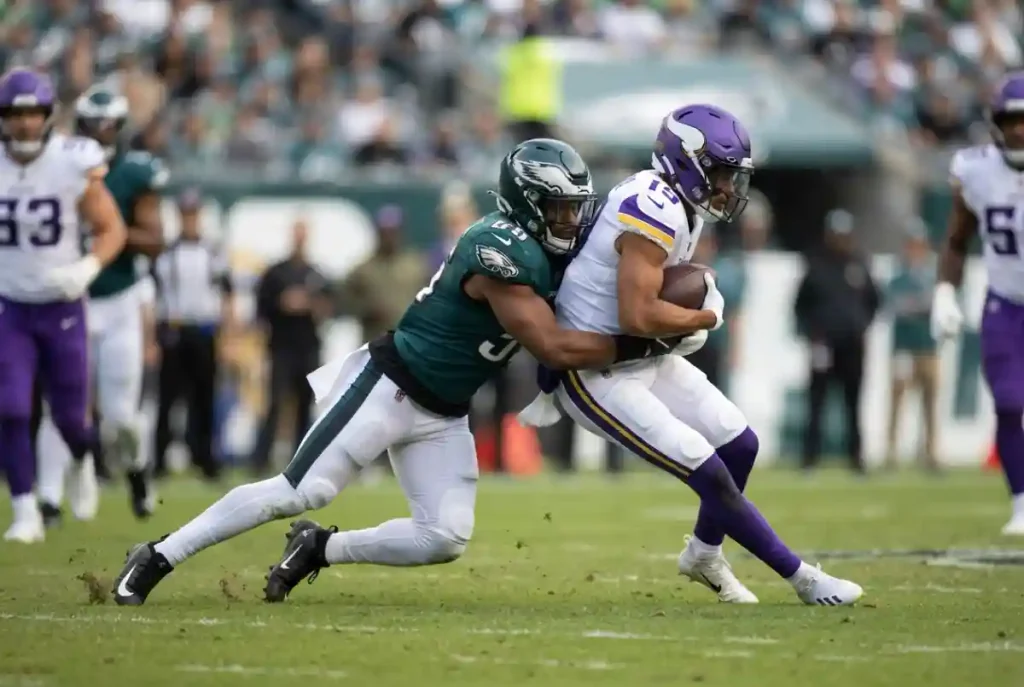
The Eagles defense played a major role in the victory. Philadelphia intercepted Wentz twice, and one of those takeaways became a defensive touchdown.
Philadelphia Defensive Highlights
| Player or unit | Contribution |
|---|---|
| Jalyx Hunt | Interception returned 42 yards for a touchdown |
| Andrew Mukuba | Recorded an interception |
| Eagles defense | Two interceptions and one defensive touchdown |
Hunt’s interception return was among the most important plays of the afternoon. Instead of allowing Minnesota to build momentum, Philadelphia turned a defensive stop into seven points.
Mukuba’s interception gave the Eagles another takeaway. Philadelphia did not lose a fumble, so it finished the game with a clear advantage in the turnover battle.
Minnesota’s defense recorded three sacks against Hurts. The Vikings also limited Barkley to 44 rushing yards, showing that they had success in some areas. However, they did not record an interception or force a fumble from Philadelphia.
The difference was how each defense handled the opposing passing game. Minnesota pressured Hurts but allowed explosive touchdown throws. Philadelphia gave up passing yards to Wentz but made the turnovers that changed the score.
Team Stats Comparison
The overall numbers show a close contest in total offense, but Philadelphia was more effective at turning its opportunities into points.
| Team statistic | Eagles | Vikings |
|---|---|---|
| Final score | 28 | 22 |
| Total offensive yards | 371 | 402 |
| Passing yards | 326 | 313 |
| Rushing yards | 45 | 89 |
| Passing touchdowns | 3 | 0 |
| Rushing touchdowns | 0 | 1 |
| Interceptions thrown | 0 | 2 |
| Sacks allowed | 3 | 2 |
| Time of possession | 25:58 | 34:02 |
Minnesota finished with more total yards and held the ball for more than eight additional minutes. Those advantages did not translate into a win because Philadelphia was more productive in the passing game and scored on defense.
The Eagles gained 326 passing yards compared with Minnesota’s 313. That difference may look small, but the touchdown totals tell a different story. Hurts threw three scoring passes, while Wentz failed to throw a touchdown and was intercepted twice.
Philadelphia also made better use of its biggest plays. Smith’s 79 yard touchdown and Brown’s scoring receptions created direct points. Hunt’s interception return added another touchdown without requiring an offensive drive.
Minnesota’s yardage advantage came partly from its stronger rushing output and extended possession. The Vikings had more chances to sustain drives, but red zone struggles and turnovers limited their scoring potential.
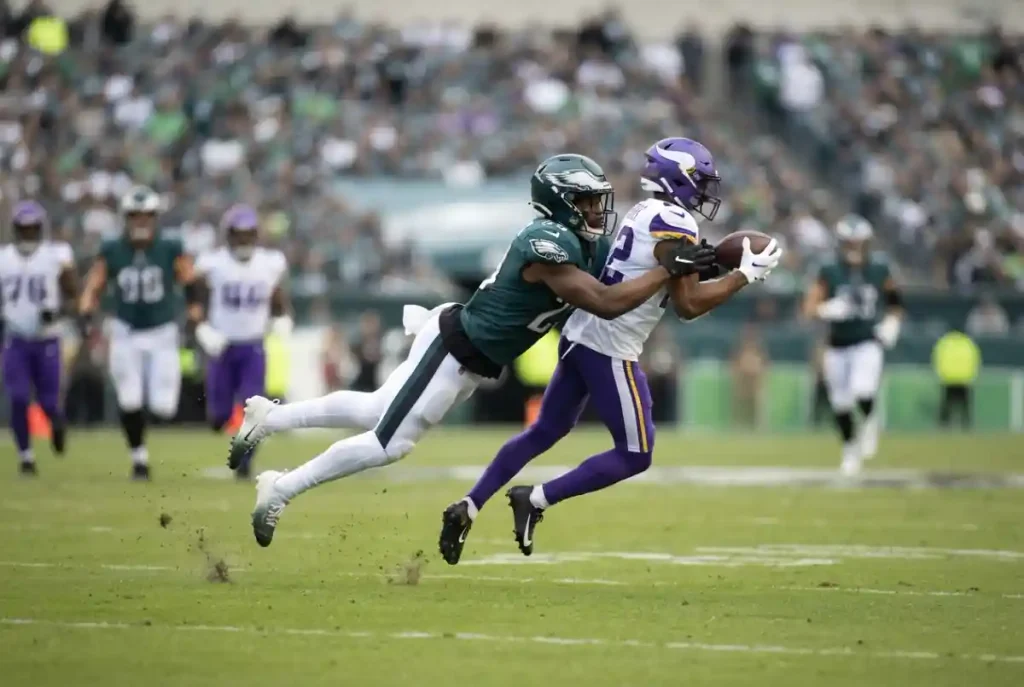
Biggest Turning Points in the Game
A.J. Brown Opens the Scoring
Brown caught a 37 yard touchdown pass from Hurts in the first quarter. The play gave Philadelphia an early lead and showed that the Eagles could attack deep downfield.
Minnesota answered with field goals, but Philadelphia continued to hold the advantage.
Jalyx Hunt’s Interception Return
Hunt intercepted Wentz and returned the ball 42 yards for a touchdown in the second quarter. This was a major swing because it gave Philadelphia seven points on defense.
The play also put pressure on Minnesota to take more risks through the air. The Vikings remained competitive, but they could not fully recover from the lost points.
DeVonta Smith’s 79 Yard Touchdown
Smith’s long touchdown reception in the third quarter gave Philadelphia another explosive score. Minnesota was trying to close the gap, and the play interrupted its progress.
The 79 yard connection was the longest pass play of the game and one of the clearest examples of Philadelphia’s ability to score quickly.
Jordan Mason Keeps Minnesota in the Contest
Mason scored on a one yard rushing attempt in the third quarter. The touchdown helped Minnesota make the game closer and gave the home team a chance to challenge Philadelphia in the final period.
Minnesota added more points in the fourth quarter, but it still needed a touchdown to take the lead.
Brown’s Late 45 Yard Catch
With less than two minutes remaining, Hurts completed a 45 yard pass to Brown on third down. The gain gave Philadelphia a first down and helped the Eagles run down the remaining clock.
It was a crucial late play because Minnesota still had all three timeouts. Philadelphia needed a first down to protect its lead, and Brown delivered the gain that allowed the offense to close out the game.
What the Player Stats Tell Us
The philadelphia eagles vs minnesota vikings match player stats reveal three main reasons Philadelphia won.
First, Hurts was more efficient. He completed 19 of 23 passes, threw three touchdowns, and avoided interceptions. Wentz threw for 313 yards, but his two interceptions and lack of passing touchdowns hurt Minnesota’s chances.
Second, Philadelphia had the more explosive receiving duo. Smith gained 183 yards and scored once, while Brown recorded 121 yards and two touchdowns. Together, they created big plays that changed the score quickly.
Third, the Eagles defense made its opportunities count. Hunt’s interception return became a touchdown, and Mukuba’s interception gave Philadelphia another important stop. Minnesota’s greater rushing yardage and possession time could not make up for those plays.
The Vikings were competitive and generated 402 total yards, but the Eagles were more decisive in the scoring areas. That is why the final six point margin favored Philadelphia despite Minnesota’s advantage in total offense.
Frequently Asked Questions
Who won the Philadelphia Eagles vs Minnesota Vikings game in 2025?
The Philadelphia Eagles defeated the Minnesota Vikings 28 to 22 on October 19, 2025, at U.S. Bank Stadium in Minneapolis.
How many passing yards did Jalen Hurts have?
Jalen Hurts threw for 326 yards, completed 19 of 23 passes, recorded three touchdowns, and had no interceptions.
How many yards did DeVonta Smith gain?
DeVonta Smith recorded nine receptions for 183 yards and one touchdown. His longest catch was a 79 yard touchdown reception.
How many touchdowns did A.J. Brown score?
A.J. Brown caught two touchdown passes from Hurts. He finished with four receptions for 121 yards.
How did Carson Wentz perform?
Carson Wentz completed 26 of 42 passes for 313 yards. He threw no passing touchdowns and was intercepted twice.
Who led the Vikings in rushing?
Jordan Mason led Minnesota with 57 rushing yards on 15 carries. He also scored the Vikings’ only rushing touchdown.
Which Eagles player returned an interception for a touchdown?
Jalyx Hunt returned an interception 42 yards for a touchdown in the second quarter. Andrew Mukuba recorded Philadelphia’s other interception.
Why did Philadelphia win despite fewer total yards?
Philadelphia scored three passing touchdowns and one defensive touchdown while avoiding turnovers. Minnesota gained more total yards but threw two interceptions and did not record a passing touchdown.
Final Takeaway
The October 19, 2025 matchup showed how explosive passing plays and defensive turnovers can decide a close NFL game. Philadelphia won 28 to 22 because Hurts delivered an efficient three touchdown performance, Smith and Brown produced big receiving numbers, and the defense turned a key interception into a score.
Minnesota moved the ball well and won the rushing battle, but the Vikings could not overcome their passing mistakes. The result was a road win for the Eagles in a game where the most important plays mattered more than total yardage.
For readers checking the philadelphia eagles vs minnesota vikings match player stats, the standout performances were Hurts’ 326 passing yards and three touchdowns, Smith’s 183 receiving yards, Brown’s two touchdown catches, and Hunt’s defensive score.

Logan Carter writes straightforward sports guides to help fans find NFL game times, TV channels, and streaming options. He makes sports information easy to understand so readers can spend less time searching and more time enjoying the game.
1 thought on “Philadelphia Eagles vs Minnesota Vikings Match Player Stats 2026”